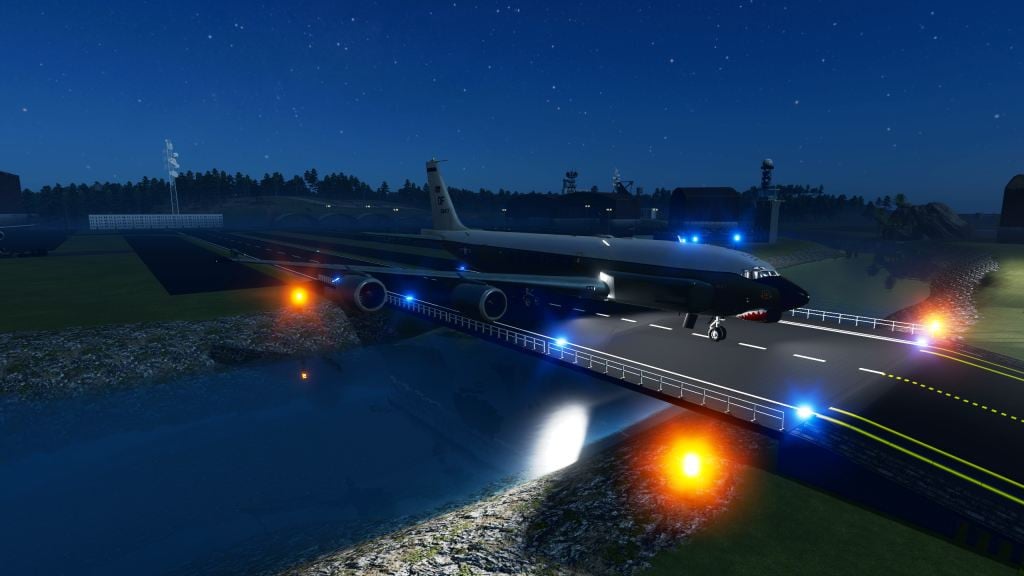
FS25 Boeing KC-135 Stratotanker 1.01

0/5,
0
Stimmen
Description
The Boeing KC-135 Stratotanker is a four-engine strategic military tanker aircraft developed and manufactured primarily by Boeing for the United States Air Force (USAF). Derived directly from the Boeing 367-80 prototype, the KC-135 made its maiden flight in August 1956 and officially entered active service in June 1957. For decades, it has established itself as the undisputed backbone of the Western world's aerial refueling fleet, enabling the projection of global air power without relying exclusively on foreign air bases or intermediate stops.
Features
- Engine Configuration and Propulsion: Originally equipped with Pratt & Whitney J57 turbojet engines, the vast majority of the fleet adopted CFM International CFM56 turbofan engines, which increased thrust and improved fuel efficiency by over 25%.
- Aerial Refueling System (Boom System: Features a rigid, telescopically extendable flying boom, with many airframes also supporting probe-and-drogue systems for international allies and US Navy/Marine Corps aircraft.
- Payload Capacity and Cabin Space: Internal structural fuel tanks capable of transferring over 90,000 kg of fuel, and a reinforced floor for transporting military palletized cargo and passengers.
- Multi-Mission Platform: Versatile design enabling variants such as the RC-135 for electronic intelligence and strategic reconnaissance and the OC-135 for observation missions.
- Global Force Multiplier: Exponentially extends the combat radius, loiter time, and weapons payload of strategic bombers, tactical fighters, and AWACS aircraft.
- Mobility and Aeromedical Evacuation: Capable of international logistics airlift, rapid deployment troop transport, and aeromedical evacuation (MEDEVAC) missions.
The Boeing KC-135 Stratotanker is a four-engine strategic military tanker aircraft developed and manufactured primarily by Boeing for the United States Air Force (USAF). Derived directly from the Boeing 367-80 prototype, the KC-135 made its maiden flight in August 1956 and officially entered active service in June 1957. For decades, it has established itself as the undisputed backbone of the Western world's aerial refueling fleet, enabling the projection of global air power without relying exclusively on foreign air bases or intermediate stops.
Features
- Engine Configuration and Propulsion: Originally equipped with Pratt & Whitney J57 turbojet engines, the vast majority of the fleet adopted CFM International CFM56 turbofan engines, which increased thrust and improved fuel efficiency by over 25%.
- Aerial Refueling System (Boom System: Features a rigid, telescopically extendable flying boom, with many airframes also supporting probe-and-drogue systems for international allies and US Navy/Marine Corps aircraft.
- Payload Capacity and Cabin Space: Internal structural fuel tanks capable of transferring over 90,000 kg of fuel, and a reinforced floor for transporting military palletized cargo and passengers.
- Multi-Mission Platform: Versatile design enabling variants such as the RC-135 for electronic intelligence and strategic reconnaissance and the OC-135 for observation missions.
- Global Force Multiplier: Exponentially extends the combat radius, loiter time, and weapons payload of strategic bombers, tactical fighters, and AWACS aircraft.
- Mobility and Aeromedical Evacuation: Capable of international logistics airlift, rapid deployment troop transport, and aeromedical evacuation (MEDEVAC) missions.
External Download Links:
- Modsfire.com - FS25_AVION_RADAR.zip [20.33 MB]
Das könnte Sie auch interessieren »









0 Kommentare
Es sind noch keine Kommentare vorhanden. Seien Sie der Erste, der kommentiert!